
Getting Ready for Winter Power Cuts and Frozen Pipes in Niseko: Home Prep for a Hokkaido Winter (2026-27)
Niseko Hub Editorial Team · 2026/11/06
A Hokkaido winter brings two things that catch newcomers out: short power cuts during a snowstorm, and water pipes that freeze and burst in a hard cold snap. Both are normal here, and your prep is easiest if you split it in two. One pile keeps you warm when the electricity stops; the other keeps your pipes from freezing and gets you through a water outage. Put both together inside the house before the first cold snap, not during it.
The thing that surprises people from warmer countries most is that the heating runs on electricity. A kerosene FF heater or fan heater burns oil, but the fan and ignition need power, so they all stop in a blackout. For how heating works and what it costs, see how much does heating cost per month in a Niseko winter?; for the full seasonal setup, see what should you get ready before the first snow?. Start with the big picture.
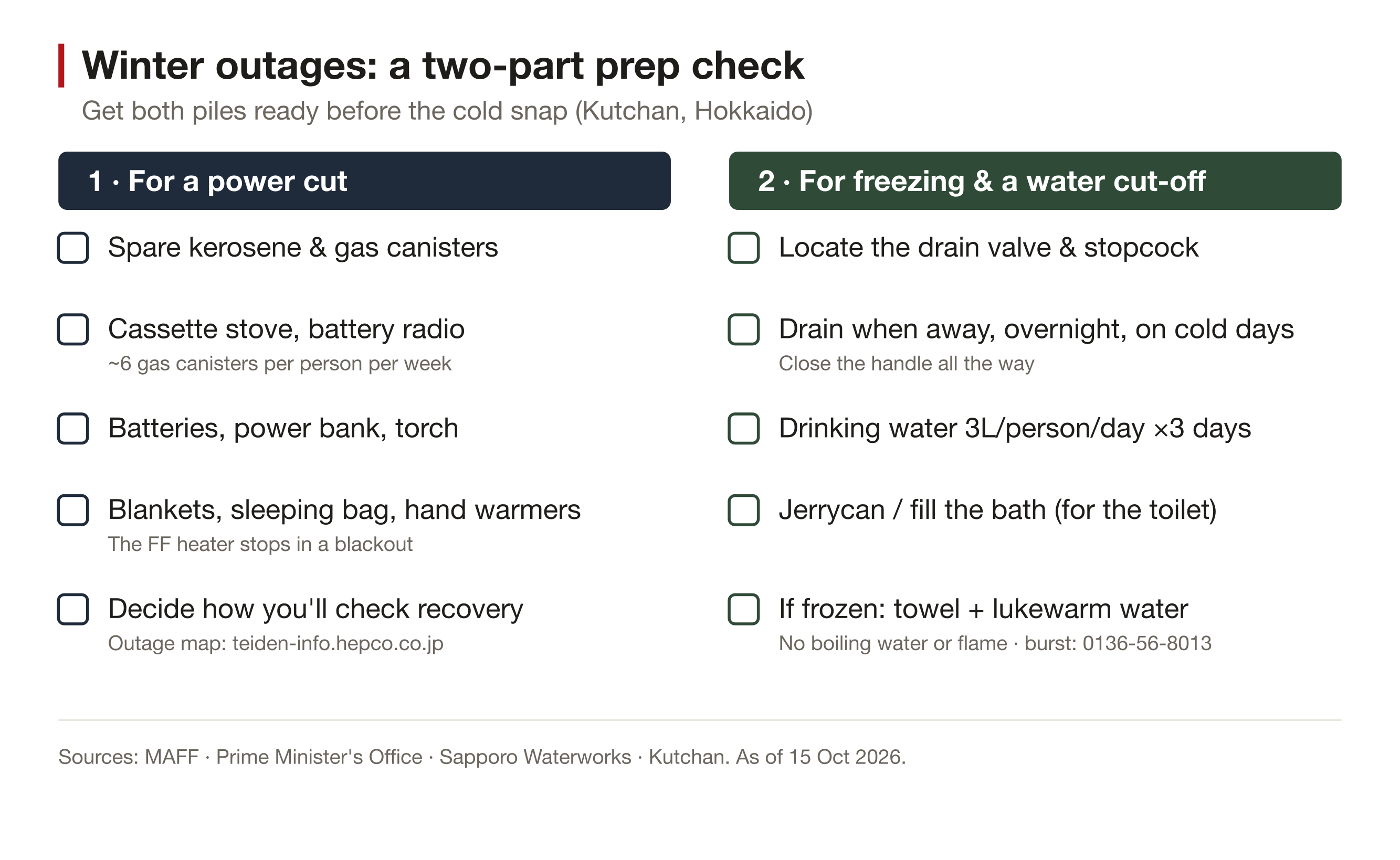
*Two piles, two sets of contacts: one for a power cut, one for freezing and a water cut-off. Sources as cited in the text (as of 15 Oct 2026).*
Treat a power cut as a "when," not an "if"
If wind or heavy snow brings down a line, a cut of a few hours to half a day can happen. So gather your kit on the assumption it will, rather than scrambling when it does. Keep spare kerosene and spare gas canisters on hand. Keep a cassette gas stove, batteries and spares, a charged power bank, a torch, and a hand-crank or battery radio somewhere you can reach in the dark.
Public agencies give amounts to aim for. For a heat source, plan on roughly six cassette gas canisters per person per week; the canisters keep for about seven years and the stove for about ten (Ministry of Agriculture, Forestry and Fisheries, checked 15 Oct 2026). For drinking water, store about three litres per person per day, at least three days' worth and a week's worth for a large disaster (Prime Minister's Office, same date). Shops can sell out once a cold snap is forecast, so stock up during November.
When the power goes, protect your body heat first
In a blackout, the real danger is the cold. The FF heater and fan heater both stop, so until the heat comes back you play defence and hold on to your body heat. If there are a few of you, gather in one room and wrap up in blankets, a sleeping bag, layers, and disposable hand warmers. A lot of heat escapes through the windows, so closing the curtains and covering them with a thick cloth or cardboard already helps. Save your phone battery for recovery updates and for staying in touch.
You can check recovery by area on the Hokkaido Electric Power Network outage information site (checked 15 Oct 2026). The network handles outages and line faults around the clock, but never go near a drooping line or a leaning pole. If there is any risk of fire or a shock, call 119 or 110. In a snowstorm, assume the repair itself will take time, and plan to stay warm for a while.
Stop pipes freezing with the "water drain"
Water is next. Pipes here freeze most easily when the house is empty, overnight, and through a run of days that stay below zero, and a frozen pipe can then burst. The basic defence is the water drain, or mizunuki: you close the drain valve inside the house and empty the water out of the pipes. Sapporo's waterworks warns that if the handle is only half turned, water stays behind and causes the freeze or burst (Sapporo Waterworks Bureau, checked 15 Oct 2026).
What to do. First, find where your own drain valve and main stopcock are, now, before anything freezes. Drain the water before you go out, before bed, and on the coldest days. Letting a thin trickle run from a tap also helps as a backup, but the drain is the main method. If you rent, ask your agent or landlord when you move in whether the place needs draining, how it's done, and what to do about the water heater.
If it freezes, or if it bursts
If a pipe does freeze, don't rush in with boiling water or a flame. Pouring hot water straight onto a tap or pipe, or holding a flame to it, risks a burst or a fire (Sapporo Waterworks Bureau, checked 15 Oct 2026). Either wait for it to thaw on its own, or wrap a towel around the exposed pipe or tap and pour warm water slowly over the towel.
If it bursts and water sprays out, close the main stopcock or drain valve to stop the flow before you call anyone. In Sapporo's case, the waterworks does not do freeze repairs; you call a registered water-supply contractor and pay the cost yourself. In Kutchan, check with the Waterworks Division (0136-56-8013, Kutchan town waterworks). Contacts and rules change, so confirm the details with the town directly.
Store water in case the supply stops
A freeze or a broken pipe can cut the water off, so put water aside in advance. Keep three litres per person per day for drinking, for three days, plus a jerrycan or bottles of water for everyday use. Fill the bathtub and that water covers a toilet you can't flush. While the supply is off, it helps to keep a few things you only have to heat, so you're not cooking and washing up with water you don't have.
Before the cold snap, put the numbers on one page
The thing that actually works is one sheet of contacts stuck on the fridge, so nobody is hunting around when it matters. Power: the Hokkaido Electric Power Network outage information site. Water outage or a burst: Kutchan Waterworks Division (0136-56-8013). Fire or ambulance: 119. The car side of winter is its own job: dead batteries and snow on the carport are in how do you protect your car through a Niseko winter?, and getting unstuck is in stuck in the snow, how do you get out?.
A local tip: until you're used to mornings cold enough to reach the inside of the front door, and boiling water in a kitchen that smells of kerosene, it's less to worry about if you put the power kit and the freeze kit together all at once.
FAQ
If the power goes out, does the kerosene heater stop too?
Most home FF heaters and fan heaters use electricity to ignite and to run the fan, so they stop in a blackout. Until the heat comes back, protecting your body heat with blankets, a sleeping bag, layers and hand warmers comes first. A cassette gas stove lets you boil water for a hot drink, but keep the room ventilated.
Do I have to drain the water every day?
Not every day: you drain when the house will be empty for a while, overnight, and through a run of days that stay below zero. The threshold varies by house, so find your drain valve and stopcock first, and if you rent, ask the agent or landlord how it's done.
If a pipe freezes, can I pour hot water on it?
Don't pour boiling water straight on it or hold a flame to it, and you risk a burst or a fire. Wait for it to thaw, or wrap the exposed pipe or tap in a towel and pour warm water slowly over the towel. If it bursts, close the stopcock and call the Kutchan Waterworks Division (0136-56-8013) or a registered contractor.
Where do I check for outage and water information?
You can see power cuts by area on the Hokkaido Electric Power Network outage site. For a water outage or a leak, call the Kutchan Waterworks Division (0136-56-8013). For storms and cold snaps, check the day's weather and snow before you head out.
— Niseko Hub Editorial Team
Niseko Snow Letter (weekly, free)
Snow conditions, this week’s events and when to book your stay — every week.
Unsubscribe anytime. Privacy policy