
Travel & Stay
How Many Days in Niseko? What 3, 5 and 7 Nights Actually Buy You (2026-27)
Niseko Hub Editorial Team · 2026/10/08
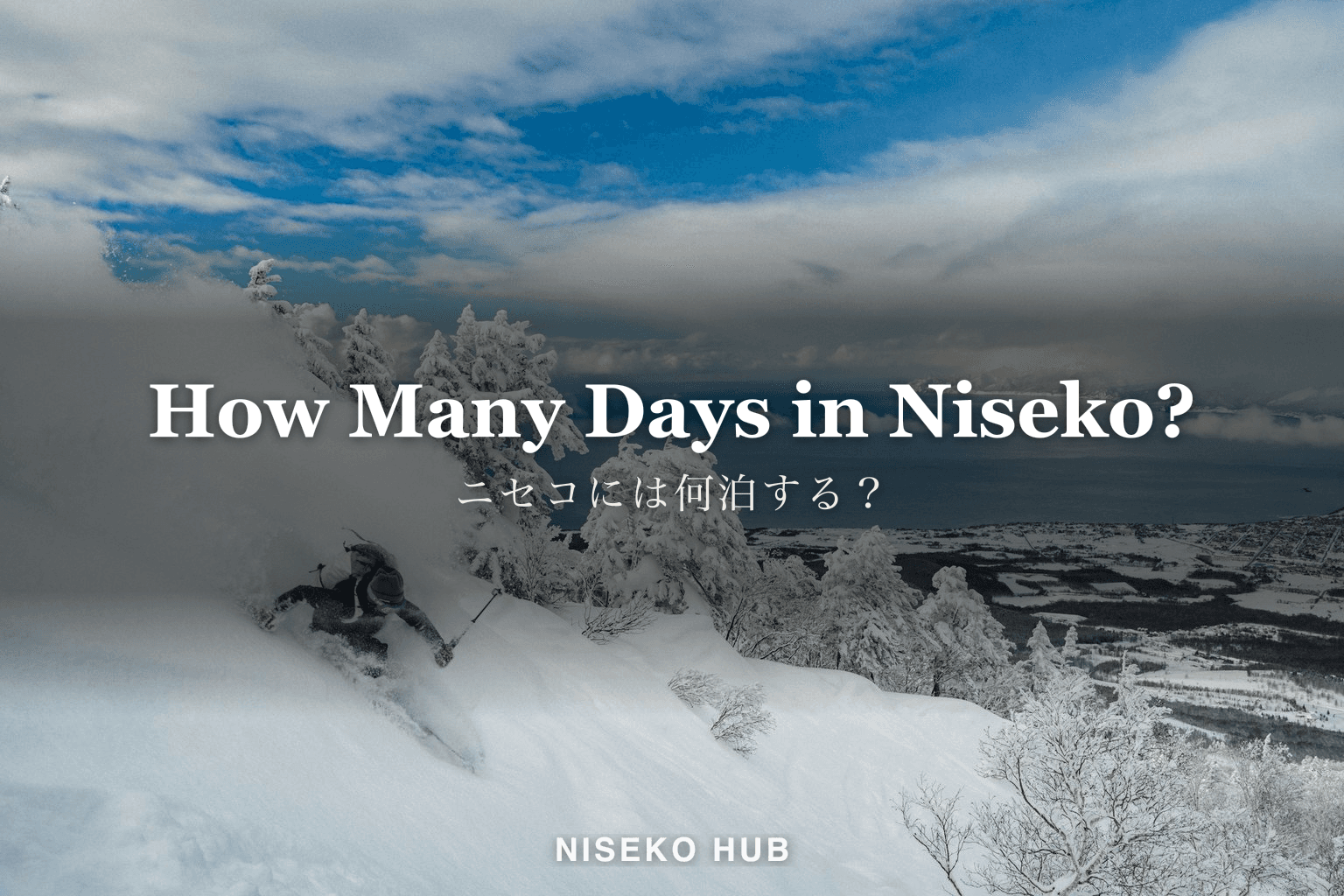
A week off, and you want to know how much of it belongs in Niseko. Book five nights. That gives you four full days on the mountain plus a short last morning, and one of those four days is the one you can afford to lose to weather. Three nights is two full days of skiing and a lot of bus. Seven nights gives you six full days, which is more than most pairs of legs want in a row, so two of those nights do better in Sapporo.
The reason the arithmetic is not simply "nights minus nothing" is that New Chitose Airport is about two and a half hours away, and the bus timetable eats both ends of your trip. Every price and time below is the operator's published 2026-27 figure, checked on 5 October 2026. Australian summer school holidays sit inside Niseko's peak period: the New South Wales Eastern Division runs 18 December 2026 to 27 January 2027 (NSW Government) and peak runs 24 December to 28 February. If your dates can move outside it, what changes in a cheaper week? compares the snow and the crowds.
Your arrival and departure days are not full ski days
Here is the Hokkaido Resort Liner's own 2026-27 timetable between New Chitose and the Hirafu No. 1 car park, at ¥6,000 one way for adults and ¥5,000 for ages 3 to 11 (Hokkaido Access Network).
| Leaves the airport | Reaches Hirafu | Leaves Hirafu | Reaches the airport |
|---|---|---|---|
| 10:00 (domestic terminal only) | 12:45 | 7:50 | 10:45 |
| 11:00 (domestic terminal only) | 13:45 | 9:50 | 12:45 |
| 12:00 (domestic terminal only) | 14:45 | 11:40 | 14:35 |
| 14:00 | 16:45 | 13:50 | 16:45 |
| 16:00 | 18:45 | 14:40 | 17:35 |
| 18:00 | 20:45 | 15:50 | 18:45 |
| 19:40 | 22:25 |
Times are at the international terminal unless marked. Watch the dates: the airport to Niseko direction runs 1 December 2026 to 30 March 2027 and the return 2 December to 31 March, but the 19:40 departure only starts on 7 December, and one of the 16:00 services runs 15 December to 15 March. In early December the bottom row is not there.
The operator asks you to leave 90 minutes or more between an international arrival and the bus, and 120 minutes or more between the bus and an international departure. Add those gaps to the table and the picture is blunt. If you connect through Tokyo and land at the domestic terminal, the morning departures open up. Going home, the 11:40 bus gets you to the international terminal at 14:35, which fits a flight from about 16:35, and it means leaving the mountain at 11:00. Lifts at Annupuri run from 8:30 in peak season (Niseko Annupuri), so that last morning is two and a half hours, not a day.
Read your landing time like this:
- Wheels down by about 12:30: the 14:00 bus, in Hirafu at 16:45
- Later than that: the 16:00 or 18:00 bus, arriving after dark
- An evening landing: the last bus reaches Hirafu at 22:25, so that's effectively a next-day start
A local tip: book the bus in the same week you book the room, because the cancellation charge is 30% from 7 days out, 40% the day before and 50% on the day, and because the luggage allowance is ski gear plus one more item per person. For taxis, private transfers and the rest of the options, see what is the easiest way from the airport with bags and kids?
A 16:45 arrival in Hirafu can still ski that night
At Grand Hirafu, night skiing runs 16:00 to 19:00, from 12 December 2026 to 22 March 2027 (Grand Hirafu). You're staying in Hirafu and you reach it at 16:45, so the bus doesn't end your day. Drop the bags, pick up rental gear and you can be on a lit run before 18:00.
Buy the night on its own ticket, not a day pass. The Hirafu & Hanazono night-only ticket is ¥6,400 at the window and ¥5,700 online for adults, and ¥3,800 or ¥3,400 for ages 4 to 12 (Grand Hirafu); at Annupuri a night ticket is ¥3,700 and the lights run to 19:30 (Niseko Annupuri). Start your multi-day pass the next morning, because a multi-day pass is valid on consecutive days only, and starting it on arrival night spends a whole day on two hours of skiing. Keeping the night off your main pass has a second reason: online passes can't be refunded or changed. The consecutive-days rule helps at the far end too, where a multi-day pass stays valid until night skiing finishes on its last day.
3, 5 or 7 nights: the days you actually ski
Booking N nights puts you in town for N plus one calendar days. Take the first and the last off the top, assuming an international flight at each end, and this is what is left.
| You book | Days in Niseko | Full days on snow | Last morning | Days you can lose |
|---|---|---|---|---|
| 3 nights | 4 | 2 | yes, about 2.5 hours | 0 |
| 5 nights | 6 | 4 | yes | 1 |
| 7 nights | 8 | 6 | yes | 2 |
Three nights works if Niseko is one stop on a longer Japan trip and you have already seen snow this winter. It does not work as the whole point of the trip, because a single storm day takes half of your skiing with it. Five nights is the first length where the mountain owes you nothing: four full days is enough to find the trees, learn where the wind comes from, and you can write one of the four off without ruining the week. Seven nights only pays off if you break it up, which is the next section.
Which pass length to buy: one day short costs ¥500
Adult All-Mountain Pass prices as published for 2026-27 (Niseko United). As of 5 October, online sales for the season were still listed as "Preparing for Sale" (Niseko United).
| Adult pass | Early (28 Nov to 11 Dec) and Spring (23 Mar to 4 Apr) | Regular (12 to 23 Dec, 1 to 22 Mar) | Peak (24 Dec to 28 Feb) |
|---|---|---|---|
| 3 days | ¥25,800 | ¥36,800 | ¥39,500 |
| 5 days | ¥42,700 | ¥61,000 | ¥65,500 |
| 7 days | ¥59,600 | ¥85,200 | ¥91,500 |
Work those out per day and the multi-day discount almost vanishes. At peak, a 1-day pass is ¥13,500, a 3-day works out at ¥13,167 a day, a 5-day at ¥13,100 and a 7-day at ¥13,071. Buying seven days at once saves you 3.2% over buying seven single days. That settles what to do about the weather, because a multi-day pass is valid on consecutive days only, so a day you sit out is a day you have paid for and lost.
So match the pass to your full days, then buy one shorter and add singles. At peak, a 4-day pass plus one 1-day pass is ¥66,000 against ¥65,500 for the 5-day. The gap is ¥500, and for that ¥500 you choose the morning of your fifth day instead of a stranger's weather model choosing it in October. The same ¥500 gap holds at 2 days plus 1 against a 3-day, and 6 plus 1 against a 7-day. Which pass to buy at all, including the cheaper Hirafu and Hanazono pass and the rules on buying online, is set out in which Niseko lift pass is cheapest for your days?
The day the lifts stand still
Niseko sits where cold Siberian air crosses the Sea of Japan, which is why the snow keeps coming and also why the upper lifts close in wind. Nobody publishes a count of lost days, and I am not going to invent one. What I will say is that in a normal January week, planning as though every booked day will be a clean day is how people end up disappointed. One day in five written off is the number I would plan around, and the first thing it buys you is permission to stop.
On a shut-down day the mountain is still open low down, where the trees hold the snow and the visibility. If the whole thing is closed, Kiranoyu is in Niseko Town, a one-minute walk from JR Niseko Station, at ¥800 for adults and ¥300 for primary and junior high school students, closed on the second and fourth Wednesday (Kiranoyu). From Hirafu, get to Kutchan Station and take the JR Hakodate Line: 15 minutes, no change, ¥360 for adults and ¥180 for children (Ekitan, checked 5 October 2026). One trap: on the United Shuttle between the four resorts, scanning a day or multi-day pass counts as using a day, so on a rest day leave the pass in the room. For reading a forecast before you commit the day, see how do you spot a powder day in Niseko?
Seven nights: give two of them to Sapporo
Six days of skiing in a row is a lot, and the sixth is rarely the best one. Splitting a week as five nights in Niseko and two in Sapporo keeps the four full ski days, one of which you can still lose to weather, adds an evening in a city, and drops your pass from a 7-day to a 5-day, which is ¥26,000 less at peak. From Kutchan Station, JR to Sapporo via Otaru is about 2 hours 16 minutes with one change, at ¥2,240 for adults and ¥1,120 for children (Ekitan, checked 5 October 2026). Note that the airport bus runs to the airport, not to Sapporo, so you book that leg separately. Sapporo first works too, but my preference is Niseko while the legs are fresh, and Sapporo last, where a late flight home is easy to reach.
So, which do you book?
A couple staying 6 nights and skiing 5 days spends roughly ¥270,000 each in a twin room, and about ¥200,000 each in a dorm, as broken down in what does a Niseko ski trip actually cost? The room is the part that sells out and the part that sets that budget, so book it first and the bus in the same week.
- 3 nights: Niseko is a side trip, not the trip. Buy a 2-day pass and add a single day if the week looks good
- 5 nights: the default for a week off. Four full ski days, one of them spendable on weather, a 4-day pass plus a single
- 7 nights, all in Niseko: only if you ski hard and happily take a rest day. Buy a 6-day pass, not a 7
- 7 nights, split 5 and 2: more variety, ¥26,000 less on the pass at peak, and an easier trip home
FAQ
How many days do you need in Niseko?
Five nights is the number that works for most people on a week off: four full days on the mountain and a short last morning, with one of those four days free to lose to weather. Three nights leaves you two full days of skiing, which a single storm day can halve.
Why doesn't a 5-night trip give 5 full ski days?
Because New Chitose Airport is about two and a half hours away at each end. On the 2026-27 Hokkaido Resort Liner timetable, the first bus an international arrival can realistically take reaches Hirafu at 16:45, and getting a flight home from about 16:35 means leaving Hirafu at 11:40.
Can I ski on the day I arrive?
Between 12 December 2026 and 22 March 2027 Grand Hirafu runs night skiing 16:00 to 19:00, so a 16:45 arrival in Hirafu still leaves you an evening. Buy the night on its own ticket (the Hirafu & Hanazono night ticket is ¥6,400 at the window, ¥5,700 online) and start your multi-day pass the next morning.
Is a 7-day lift pass cheaper per day than a 3-day?
Barely. At the published 2026-27 peak prices, a 3-day All-Mountain Pass works out at ¥13,167 a day, a 5-day at ¥13,100 and a 7-day at ¥13,071, against ¥13,500 for a single day. Multi-day passes are valid on consecutive days only, so a long pass can cost you more than it saves.
Should I split a week between Niseko and Sapporo?
If you have seven nights, yes. Five in Niseko and two in Sapporo keeps all four full ski days, saves ¥26,000 on a peak pass compared with a 7-day, and puts you near the airport for the flight home. JR from Kutchan to Sapporo is about 2 hours 16 minutes and ¥2,240.
— Niseko Hub Editorial Team
Niseko Snow Letter (weekly, free)
Snow conditions, this week’s events and when to book your stay — every week.
Unsubscribe anytime. Privacy policy