
The Best Terrain in Niseko for Advanced Skiers: Steeps, Trees and Where the Good Snow Hides (2026-27)
Niseko Hub Editorial Team · 2026/11/08
Niseko keeps advanced skiers busy even without leaving the ropes. The lines to chase are the ungroomed pitches up top at Grand Hirafu, the well-spaced birch trees off the Hanazono #1 chair, the fall-line drops along the Niseko Village gondola, and the high, light snow that lingers at Annupuri. All four resorts carve up the same mountain, and one all-mountain pass rides every lift. The real strength here is less about which resort is best and more about reading the day's snow and wind, then going where it points. Start by checking what the snow is actually doing in How do you spot a powder day in Niseko?, then build your day around it.
This article stays inside the resort boundary, where the ski area is managed and patrol is watching. Anything through a gate is backcountry, with completely different gear and rules, so we kept that for Niseko Rules and the backcountry gates. Here we focus on where the riding gets interesting while you stay inside the ropes.
Each resort has its own terrain character
The four resorts differ in size and pitch, so advanced skiers do well to split where they base and where they ride. Grand Hirafu has 22 courses and the widest range of terrain, with long top-to-bottom runs and ungroomed faces up high. Hanazono leans gentle and family-friendly, but the well-spaced trees off the #1 chair hold deep snow right after a storm thanks to the low elevation. Niseko Village runs fall-line pitches along its gondola, quieter and slower to get tracked out. Annupuri climbs highest of the four, keeps light snow longer, and stays thin on people. For the full picture of size, course counts, and night skiing, see Comparing the four Niseko resorts.
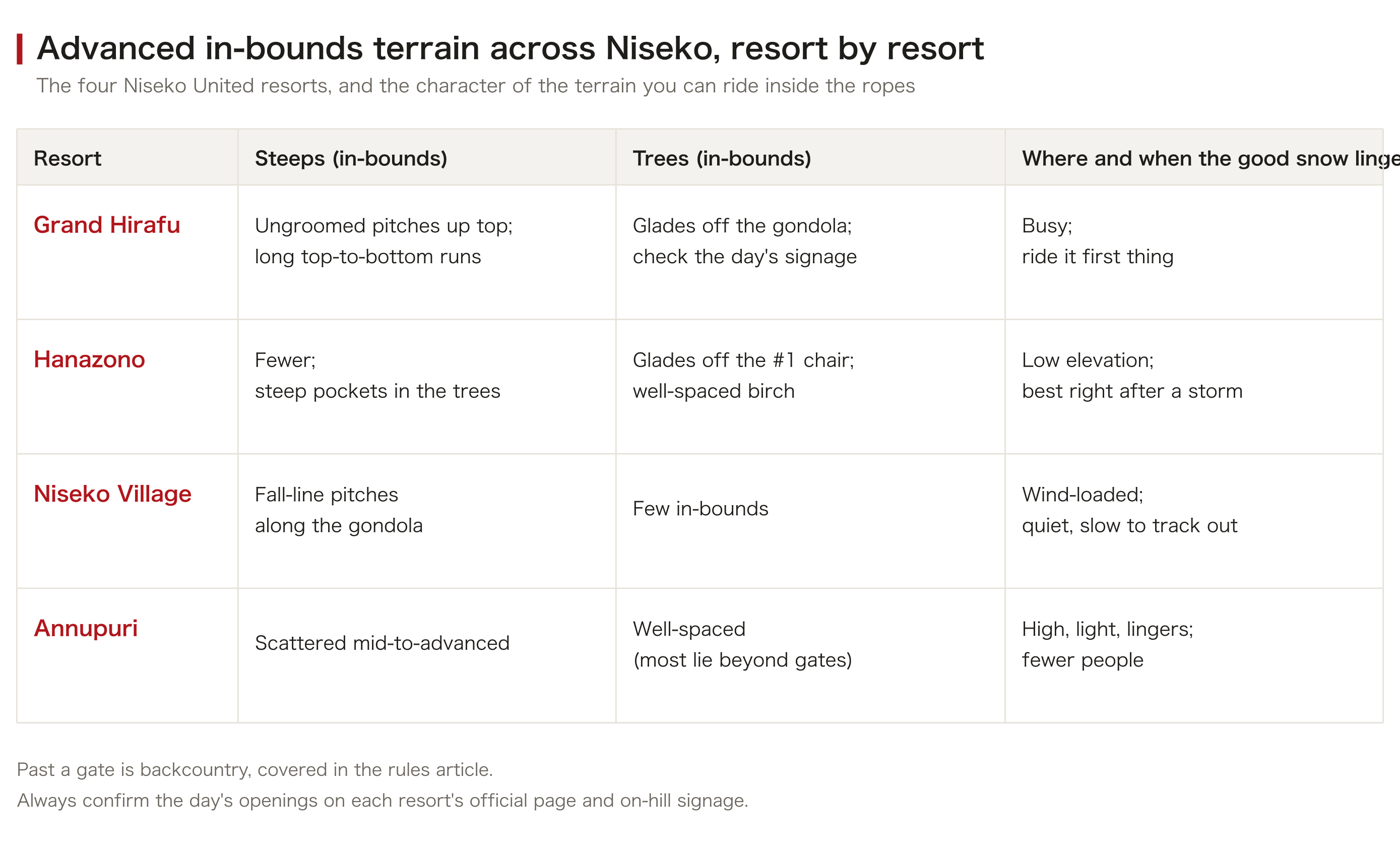
*The character of the terrain you can ride in-bounds. Past a gate is backcountry, and the day's openings are confirmed on each resort's official page and on-hill signage.*
In-bounds steeps and ungroomed terrain
If you want pitch, start up top at Hirafu. Above the gondola and the chairs you get wide ungroomed faces and long courses that keep changing gradient. The nice part of Hirafu is that you can set an edge on the morning groomers and then drop straight into the ungroomed on the same pass. Niseko Village also holds fall-line drops along its gondola, and with fewer people than Hirafu, the same pitch stays smooth for longer. Annupuri skis mellow overall, but mid-to-advanced courses are scattered through it, and the high elevation keeps the snow light. Hanazono has few in-bounds steeps, though the trees hide some genuinely steep pockets.
Where you may ride the trees
In-bounds tree runs mean only the zones the resort has marked as open to ski. At Hanazono, step off the #1 chair and the birch trees open up with wide spacing, low enough that the snow sits deep, and gentle enough in pitch to try your first trees. Hirafu has trees along the gondola, but how far you may go changes by the day, so check the signage and ropes for the boundary. One line matters most here. The moment you pass a numbered gate, you are in the backcountry, in beacon, probe, and shovel country. What to carry and how to prepare is laid out in A beginner's guide to Niseko backcountry gear. Not confusing in-bounds trees with what lies past a gate is the first thing that keeps you safe.
Good snow sits where wind and sun put it
Even on one resort, the slopes that hold deep snow shift with the day's wind. Niseko's winter wind generally blows from the northwest, so the leeward side (roughly the east-to-southeast aspects) loads up with blown snow, while the windward side gets scoured firm. I grew up skiing in Hokkaido from the age of three and used to teach here as an instructor, and when I hunt for good snow the first thing I check is the overnight wind direction. It tells me which faces filled in by morning. Sun matters too. South-facing slopes turn heavy and wet once the light hits, while north-facing courses keep the snow light for longer. On flat-light days when you cannot read the bumps, head for the trees, where the branches throw shadow and the surface becomes legible again.
Move before it gets busy
Niseko powder often comes down to what time you ride rather than how much fell. The popular lines at busy Hirafu and Hanazono get tracked out by late morning, even the day after a big dump. So the faces where you want the deepest snow are a first-lap job. Plenty of advanced skiers line up for the gondola or chair at opening and go straight to their target face on run one. To find deep snow in the afternoon, move to quieter Niseko Village or Annupuri, or swing to the leeward wind-loaded pockets, where it can still be sitting untouched. Crowds and prices peak hardest over the New Year and Lunar New Year weeks, and starting half an hour earlier visibly changes the snow you get to ride.
Safety still counts inside the ropes
Patrol is watching in-bounds, but always follow closure signs, ropes, and patrol's instructions. Slopes with avalanche or hazard risk get closed off temporarily, in-bounds included. The other thing to respect in the trees is not going in alone. Fall headfirst into a tree well, where the snow around the trunk is loose, and you may not get out by yourself. Keep your group within earshot, and when one skier drops into the trees, another waits where they can see them. And past a gate is a different world, where clear skies turn fast and search and rescue is charged at a minimum of 100,000 yen (Niseko United, confirmed 2026-10-15). Pushing the terrain in-bounds and heading out a gate call for separate preparation, so keep the two apart in your head.
FAQ
Where should advanced skiers ski in Niseko?
In-bounds, the steeps and long runs are up top at Grand Hirafu, the well-spaced trees are off the Hanazono #1 chair, the quiet fall-line pitches are at Niseko Village, and the high elevation that holds light snow is Annupuri. One all-mountain pass lets you move between all four, so you can pick the resort by the day's wind and snow.
Can you ski the in-bounds tree runs?
You can, within the zones the resort has marked as open, such as the managed trees inside the ropes near the Hanazono #1 chair. But past a numbered gate you are in the backcountry, where beacon-and-shovel gear and the Niseko Rules apply. Confirm each day's openings on the on-hill signage.
Where does the good snow linger?
On the day's leeward slopes and the shadier north-facing courses. Niseko's winter wind generally comes from the northwest, so snow loads onto the east-to-southeast faces that sit in its lee. Popular lines get tracked out by midday, so the deep snow is a first-lap job.
Is in-bounds enough for advanced skiers?
For one or two days, the in-bounds steeps, ungroomed faces, and trees give you plenty to ride. If you stay longer and want to widen the terrain, go past the gates with a guide and the right gear first. That order is the safe one.
Are Niseko Village and Annupuri good for advanced skiers?
Both stay thin on people and slow to track out. Niseko Village holds fall-line drops along its gondola, and Annupuri keeps light snow longer thanks to its high elevation. Take Hirafu for the amount of terrain and long runs, or these two for the quiet and the snow quality.
— Niseko Hub Editorial Team
Niseko Snow Letter (weekly, free)
Snow conditions, this week’s events and when to book your stay — every week.
Unsubscribe anytime. Privacy policy