
The Niseko Rules and Backcountry Gates Explained: How to Ski the Powder Safely (2026-27)
Niseko Hub Editorial Team · 2026/11/04
The Niseko Rules are the shared code for leaving the resort boundary into the backcountry, used across all four Niseko resorts (Hirafu, Hanazono, Niseko Village and Annupuri). There isn't much to memorise: you leave only through a gate, you never duck the boundary ropes, and everything past a gate is your own responsibility. If you came for the powder, sort out "where am I allowed to ski" before your first run. We cover reading the snow in How do you spot a powder day in Niseko?, but these rules come first.
What are the Niseko Rules?
The Niseko Rules are the set of requirements that Niseko United sets for anyone leaving the groomed runs. At the core: always use a gate to enter the backcountry, never duck the boundary ropes, and stay out while a gate is closed (Niseko United, "Niseko Rules", checked 15 October 2026). The rules also say never enter off-limits areas at any time, wear a helmet and carry an avalanche beacon in the backcountry, and that primary-school children need an adult with them.
This isn't Niseko being unusually strict. Light, dry snow pulls people in from all over the world, and that same snow slides on a steep slope. The gates and the rules are the minimum line that keeps the freedom to ride while cutting down accidents. People who break them can have their lift pass confiscated or be refused a new one. So for a visitor, knowing the rules is the same thing as protecting your day on the hill.
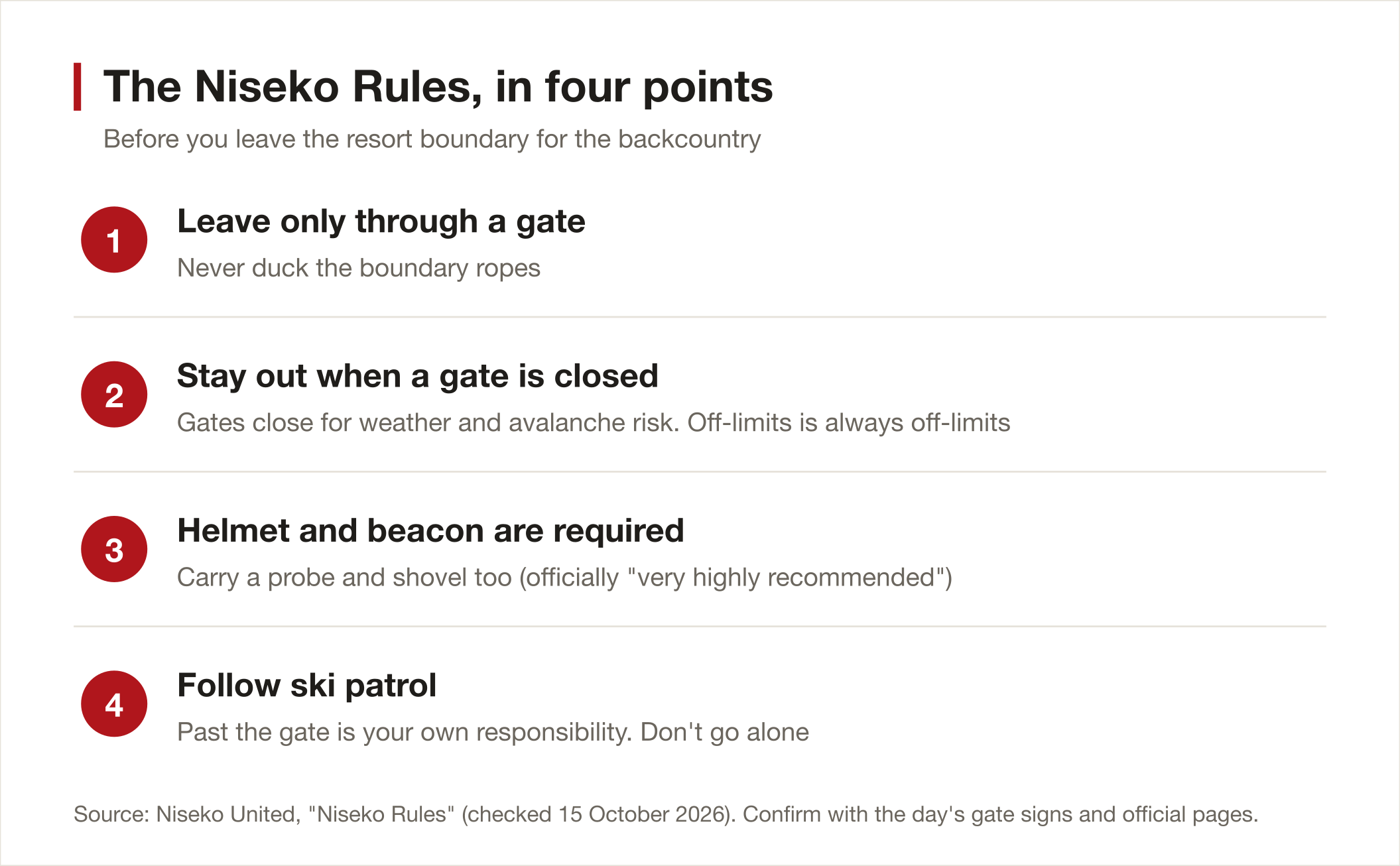
*The Niseko Rules at a glance. Before you go, confirm with the day's gate signs and the official pages.*
How gates open and close
A gate is the doorway between the resort's runs and the backcountry beyond. Each one is numbered, and ski patrol decides whether to open or close it based on the day's weather and avalanche risk. Leaving through a closed gate is prohibited, and a gate that's open in the morning can be shut by the afternoon. "It was open yesterday" doesn't count. Before you go out, read the sign on that gate, that day, with your own eyes.
For snow and avalanche information, the Niseko Avalanche Information service, run by the Niseko Avalanche Institute, is the area's reference, and the official pages point to it. It posts in English alongside Japanese and updates almost daily. But it's information, not a promise that any particular line is safe. If the report itself is hard to parse, read How do you read the Niseko snow report? first so the day's signage makes more sense.
Where you can go, and where you can't
The terrain splits into three. First, in-bounds: groomed, patrolled, the runs you ski all day. Second, the backcountry past a gate: not groomed, not watched, and your own responsibility from the moment you step through. Third, off-limits areas, which you never enter regardless of the time or whether a gate is open; they're marked with ropes, nets and signs.
The line that trips people up is between the second and the third. A gate can be open while how far you may go beyond it changes day to day, and not every slope you can see from the gate is a slope you're allowed to ride. For the exact limits, go by the on-site map, the day's signs, and ski patrol. This article explains the entry point to the rules; it does not decide what's open on your day.
Minimum gear and mindset
What the Niseko Rules require is a helmet and an avalanche beacon. On top of that, the officials "very highly recommend" the full three: beacon, probe (to locate a buried rider) and shovel (to dig them out). In practice, some gates are said to turn you back without all three, so if you're heading out of bounds, plan to carry all three and practise with them before you go. We break down what to buy, and how, in Niseko backcountry gear: what do you need first?.
Mindset matters as much as kit. Don't go alone, don't overestimate yourself or your gear, and follow ski patrol. Most past accidents happened on bad-weather days. I worked as a ski instructor for a while, and teaching beginners inside the ropes turned out to be a completely different thing from trusting your own judgment past a gate. If this is your first time in the Niseko backcountry, going with a local guide is the soundest choice. Having someone who knows the mountain next to you changes the quality of every decision you make.
What travellers get wrong
The most common mistake is thinking, "I came through a gate, so this is still managed." A gate is only a doorway, and past it you're outside the managed area. The moment you step through, it's no longer a run; it's the backcountry. The weather won't cooperate either. A clear sky going to zero visibility in an hour, and your morning tracks vanishing, is nothing unusual up here.
There's a money side too. In Niseko, a minimum of ¥100,000 is charged for backcountry search and rescue, stated plainly on the official page (Niseko United, checked 15 October 2026). Add a helicopter or a hospital stay and the figure climbs. Before you fly, check that your travel insurance covers ski and snowboard injuries, and ideally off-piste accidents too. For what actually happens if you get hurt or lost, and what it costs, we lay it out in If You Get Hurt or Lost in the Niseko Backcountry.
FAQ
What are the Niseko Rules?
They're the shared code across the four Niseko resorts for anyone leaving the groomed runs. The pillars: enter the backcountry only through a gate, never duck the boundary ropes, don't leave through a closed gate, never enter off-limits areas, and wear a helmet and carry a beacon.
When are the gates open?
Ski patrol decides based on the day's weather and avalanche risk. There's no fixed timetable, and a gate open in the morning can close in the afternoon. Leaving through a closed gate is prohibited. Check the sign on the gate that day to see whether it's open.
Can I duck under a rope to get in?
No. Ducking a boundary rope breaks the Niseko Rules and can cost you your lift pass or a refusal to reissue one. To go out of bounds, enter through an open gate.
What gear do I need for the backcountry?
The Niseko Rules require a helmet and a beacon, and "very highly recommend" a probe and shovel. Because some gates turn you back without all three, plan to carry a beacon, probe and shovel. If it's your first time, go with a guide.
Does this matter for beginners or in-bounds skiers?
If you only ski in-bounds, you won't be going past a gate. That said, people do wander across a rope without realising the far side is out of bounds. Ski inside the ropes and nets and follow the arrows, and you're fine.
— Niseko Hub Editorial Team
Niseko Snow Letter (weekly, free)
Snow conditions, this week’s events and when to book your stay — every week.
Unsubscribe anytime. Privacy policy