
Travel & Stay
What Does "Free-Flowing" Mean? Spring Quality and Niseko's Waters — Sulphur vs Chloride, and Reading the Notice
Niseko Hub Editorial Team · 2026/10/14
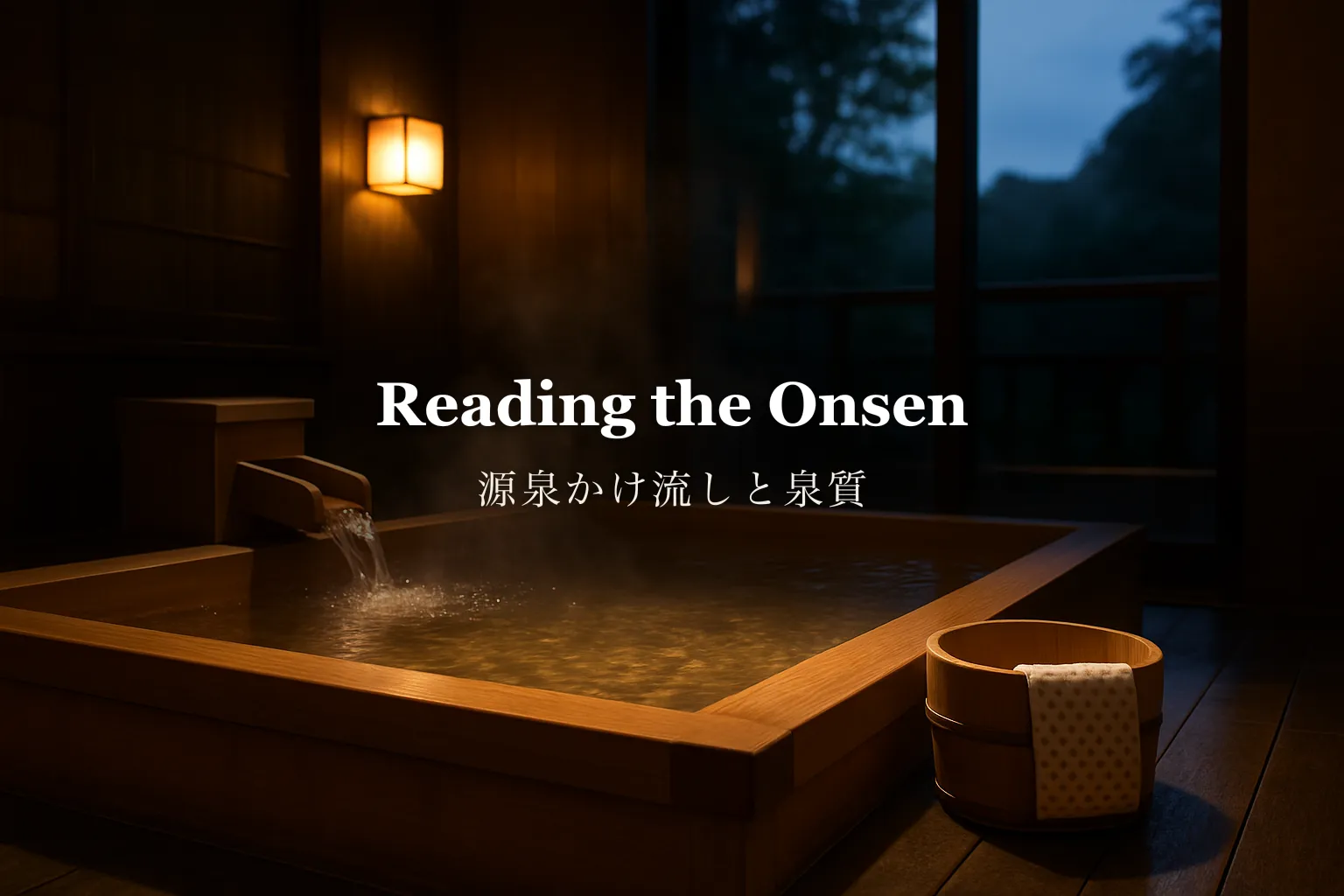
"Gensen kakenagashi" (free-flowing from the source) means fresh spring water poured continuously into the tub, with the overflow let go rather than reused. There is no fixed definition for it in the Hot Spring Law, though; it is an industry and everyday term. Once you know what the phrase means, and what kind of water Niseko and Kutchan hold, an ordinary bath tour gets far more interesting. This article sets out the basic vocabulary of onsen, and the character of the waters here, in line with official information.
This article reflects what we confirmed on 9 October 2026 against public information from Japan's Ministry of the Environment and each facility's official pages. Spring quality and notices differ by facility, so check the actual water against the posted notice on site. The etiquette of bathing itself is touched on in our guide to Japanese culture (Part 1).
What is an "onsen," anyway? The legal definition
Under Japan's Hot Spring Law, water rising from the ground counts as an "onsen" if the source is at least 25°C, or if it contains set components above a certain level (such as a total dissolved content of 1,000 mg or more per kilogram). In other words, even water that isn't hot can be an onsen if its components meet the standard (source: Ministry of the Environment, definition of onsen). Thanks to this definition, water that calls itself an "onsen" has something solid behind the name.
"Free-flowing" versus "recirculated and filtered"
"Free-flowing from the source" generally refers to a method in which fresh spring water is poured continuously into the tub, and the overflow is let go rather than reused. That said, the phrase is an industry and everyday term; it has no fixed definition in the Hot Spring Law. So you can't simply say "free-flowing is best" or "recirculated is bad."
The recirculating, filtered method passes the tub's water through a filter, disinfects it, and returns it to the tub. It saves water and makes temperature and hygiene easier to manage. The volume and temperature of a source are finite, so which method a place uses comes down to its circumstances. Which one you are stepping into is something the bath's notice, explained next, will tell you.
The notice tells you: added water, heating, recirculation, disinfection
By the entrance to a bath, you'll find a "notice of hot-spring components" required under the Hot Spring Law. It lists the source name, the spring quality, the date of analysis, and the indications and contraindications. That date of analysis tells you when the breakdown was taken; if it is quite old, the water's components may have shifted a little since, so keep that in the back of your mind. A 2005 amendment added a duty to post four more points: (1) whether water is added, (2) whether it is heated, (3) whether a recirculation system is used, and (4) whether bath additives or disinfection are used (source: on the Hot Spring Law notice (Aichi Institute of Public Health)).
In other words, whether a bath is free-flowing, or has added water or recirculation, can be judged from this notice. At a bath you're visiting for the first time, take a look at it before you step into the changing room. The water's nature shows at a glance. The notice can look daunting, but the spring quality and those four points are all you really need to catch.
Spring quality, roughly: simple, chloride, sulphur…
The Ministry of the Environment's guidelines sort spring quality into ten types: simple springs, chloride springs, hydrogen-carbonate springs, sulphate springs, carbon-dioxide springs, iron springs, acidic springs, iodine springs, sulphur springs and radioactive springs. You needn't memorise them all.
Taking just the ones easy to tell by colour and smell: a sulphur spring smells like a spoiled egg and can turn cloudy white. An iron spring tends to go reddish-brown and cloudy when it meets the air. A chloride spring contains salt and is said to warm the body well. A simple spring has a lower total of components and often feels soft on the skin. Even the same "onsen" can wear a very different face when the spring quality changes.
What kind of water is it in Niseko and Kutchan? Sulphur and chloride
The joy of the Niseko–Kutchan area is that waters of different character sit within easy reach of one another. Goshiki Onsen up in the hills, and Yukichichibu, drawn from the Oyunuma pond, are sulphur-spring types. They turn cloudy white, or shift in colour from day to day, and look every bit the "proper onsen." The smell and the effect on the skin are on the stronger side, so small children and anyone with sensitive skin shouldn't overdo it.
Niseko Kombu Onsen and Kiranoyu by Niseko Station, on the other hand, are mainly chloride-spring and hydrogen-carbonate-spring types. They are often clear to look at, and warm you from the core with a soft, lingering feel. Kiranoyu posts its water as a simple spring (hypotonic, mildly alkaline). From cloudy water to clear, you can taste the differences in spring quality in a single round, and that is the luxury of this place. Oyunuma, the pond that feeds Yukichichibu, is a dramatic sight in its own right, steaming away, and worth a stop just to look at. For each facility's exact spring quality, and whether it is free-flowing or recirculated, check the notice posted on site.
Before you get in: indications and contraindications
The notice lists "indications," the conditions a water is thought to suit. But this is not a promise that it "will work" or "cures illness." There are also "contraindications," conditions for which it is better not to bathe. When you're unwell, or worried about a long-standing condition, don't push it; avoid long soaks, and keep your fluids up as you enjoy the bath.
FAQ
Which is better, free-flowing or recirculated?
There's no blanket answer. Free-flowing lets you enjoy fresh water, while recirculated is easier to keep at temperature and hygienic. "Free-flowing from the source" has no fixed legal definition, so the best thing is to read the notice and know which method your bath uses.
Why does cloudy water have colour?
Mostly it comes from the components. Water containing sulphur can turn cloudy white, and water containing iron tends to go reddish-brown when it meets the air. The colour and cloudiness are an expression of that water's character.
Where can you bathe in a sulphur spring in Niseko?
You can enjoy sulphur-spring waters at Goshiki Onsen up in the hills and at Yukichichibu, drawn from the Oyunuma pond, among others. Access and winter hours change, so check before you go, with each facility or with our 14 recommended onsen in Niseko.
Once you can read the notice, every bath feels a good deal more interesting. For a summer bath tour, see also Niseko onsen, best in summer.
— Niseko Hub Editorial Team