
Entertainment
Why Is Niseko's Snow So Light? The Science of JAPOW, When It's Best and What It Means for Skiing
Niseko Hub Editorial Team · 2026/06/16
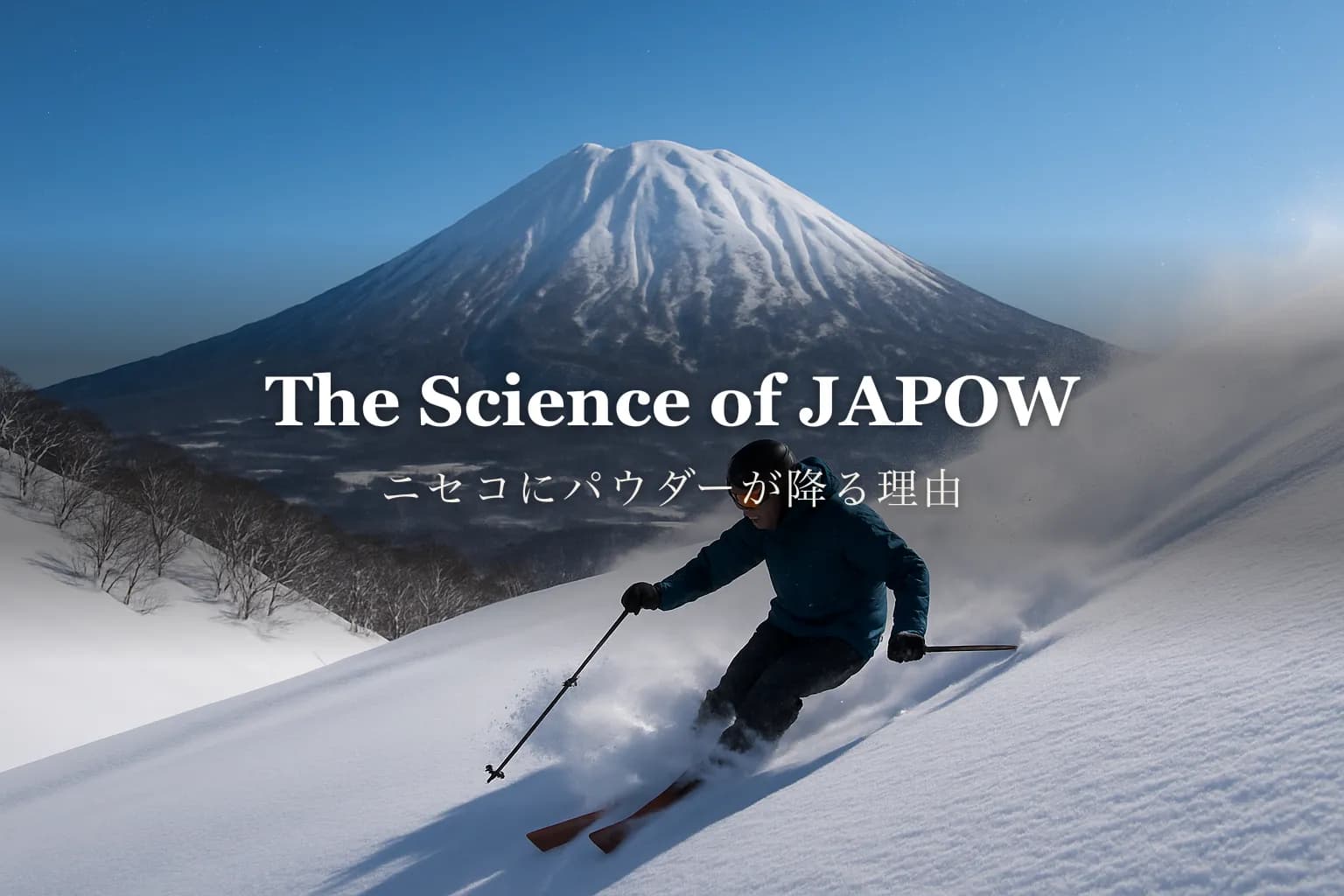
Niseko's snow is light because cold, dry wind off the continent picks up moisture over the Sea of Japan, turns into snow clouds, and dumps them on the mountains while everything is still well below freezing. It's lightest in January and February, the bottom of the cold, when even down in Kutchan the average daily low for January is -9.6°C (JMA Kutchan normals, in Japanese).
This is written for an intermediate skier flying up from Australia for about a week: how JAPOW forms, when you're most likely to get the light stuff, and what to sort out before you leave. The numbers come from the Japan Meteorological Agency's 1991–2020 normals for Kutchan and the season snowfall totals Niseko United publishes, both checked on 5 October 2026. If your dates aren't locked in yet, read it alongside When is the best time to visit Niseko?, which lays out snow, prices and crowds month by month, so you can match the numbers to your own week.
Why is Niseko's snow so light and dry?
Three ingredients: a cold continent, a warm sea and a mountain in the way. In winter Japan usually sits under a "high in the west, low in the east" pressure pattern, and the winter monsoon pours out of a high over the frozen continent. Akita University's snow and ice guide says this wind starts out "very dry and cold", then, crossing a Sea of Japan warmed by the Tsushima Current, picks up heat and water vapour from the surface and builds snow clouds (Akita University, via Akita Prefecture, PDF in Japanese.pdf)).
The same guide explains that when those clouds reach the western slopes of the mountains they're pushed upwards and drop a lot of snow. That's how it works all along the Sea of Japan side, and the Niseko range, just inland from the coast, sits right in the path. What makes Niseko's snow light is that it all happens in serious cold. JMA explains that snow falling at relatively warm temperatures holds a lot of water and tends to be "wet, heavy snow", and that a small difference in temperature decides whether you get snow, and how much of it settles (JMA, in Japanese).
The Akita University guide adds that in cold, dry snow the crystals are only loosely tangled together, so they fall apart easily. That's the cloud that blows up in front of your skis on every turn. In January, even Kutchan's average daily high is -2.0°C, so the snow rarely softens in the middle of the day.
How much snow does Niseko get? Winter 2025–26 month by month
At mid-mountain, 13.5 to 15.9 metres a season in recent winters, and around 11 metres in a lean one. At Grand Hirafu's 850m station, winter 2025–26 recorded 13.5m in total, with fresh snow on 80 days (Niseko United). By month: 3.7m in December (25 days), 6.2m in January (27 days), 2.63m in February (19 days) and 75cm in March (9 days). Before that, 2020–21 logged 1,589cm, 2021–22 1,450cm and 2022–23 1,400cm, while the lean 2019–20 season managed 1,110cm (Niseko United 2021–22, 2022–23). Niseko United says the peak commonly gets about double what the base gets, and that some parts of Niseko likely saw close to 20m in 2022–23.
Down in Kutchan, the normal snowfall is 253cm in December, 253cm in January, 187cm in February and 122cm in March, and the normal maximum snow depth for February is 181cm. For a visitor, how often it snows matters more than the season total: in January 2025–26, fresh snow was recorded on 27 of 31 days. Stay a week and you'll wake up to new snow more than once.
When is the snow lightest? January, February and March in numbers
If light snow is the goal, come between January and the end of February. The table shows Kutchan's normals (JMA) and a ratio I worked out from them: centimetres of snowfall per millimetre of precipitation.
| Month | Daily low | Daily high | Snow per 1mm of precipitation |
|---|---|---|---|
| December | -6.8°C | 0.0°C | 1.16cm |
| January | -9.6°C | -2.0°C | 1.37cm |
| February | -9.4°C | -1.0°C | 1.45cm |
| March | -5.7°C | 3.0°C | 1.24cm |
In March the normal daily high goes above freezing, which brings days when the snow softens at lunch and sets into a crust overnight. The ratio is rough: the precipitation figure includes rain, and on snowy days the gauge misses some snow in the wind, so the ratio comes out on the high side. Still, airy, light snow piles up deeper from the same amount of water, so the numbers point to January and February as the months of the lightest snow.
March can still be great. Niseko United says March 2021–22 stayed cold, with fresh snow most days in the first part of the month. March 2025–26, on the other hand, got just 75cm over 9 days. March is hit and miss from year to year, so if you come then, ski the upper mountain in the morning and the sunny lower slopes in the afternoon. How to read a big snow morning is in How to Spot a Powder Day in Niseko.
What does light snow change for an intermediate skier?
If you can get down groomed runs comfortably, Niseko's light snow is a good place to start learning deep snow. Falls hurt less, and the edges of the runs fill in again every time it snows. Start with the fresh snow left at the sides of groomers, move into the trees inside the resort once you're comfortable, and you can ski deep snow for days without going near a gate. On heavy snowfall days it's hard to see the bumps, so the lower runs among the trees are easier than the open slopes up top.
But deep, light snow hides drops and can slide. The Niseko Rules page says Niseko was once the mountain with the most avalanche deaths in Japan (Niseko Rules). That's why you can only leave the resort through the gates, and not when they're closed. Ducking a rope is banned, a helmet and an avalanche beacon are considered the minimum outside the boundary, and elementary school children can't ski out there on their own.
Search and rescue outside the resort costs at least ¥100,000, and breaking the rules can get your lift pass taken away or your use of the resort refused. The rules also strongly recommend carrying a probe and shovel as well as a beacon. If I were going through a gate for the first time, I'd hire a guide. On the morning you go, read the Niseko Avalanche Info that the Niseko Avalanche Institute puts out each day.
What to sort out before you fly
Light snow is dry, but it gets everywhere: down your collar, up your sleeves, inside your goggles. And it's light because it's cold. The coldest part of the day is sitting on a chairlift in the wind.
- Waterproof jacket and pants, with snow skirts and cuffs that seal. Bib pants help on deep days
- Layers. A base layer and a mid layer you can take off at lunch
- A neck warmer or face mask for the wind on the lift
- Goggles, not sunglasses. Plus a spare lens or cloth
- Two pairs of warm, waterproof gloves. Swap to the dry pair after lunch
- Heat packs (kairo). Sold at convenience stores
Wider skis make deep days much easier. If you're renting, ask whether they have powder skis when you book. For lift passes, the All Mountain Pass suits powder mornings when you might move over to Hanazono or Annupuri; in the 2026–27 peak season (24 December to 28 February) an adult 1-day pass is ¥13,500 (Niseko United), and it includes transport between the four resorts (Niseko United). For the off-slope side of the cold, from shoes to icy streets, see Before your first Niseko trip.
Once you're here, use "Today in Niseko" to check Kutchan's snow depth and temperature (winter) before you head out each morning. It shows the JMA readings, so you know how cold it is and how deep the snow is that morning.
FAQ
What is JAPOW, and why is Japanese snow called that?
JAPOW is skier slang for "Japan powder": the light, dry snow that falls on Japan's Sea of Japan side, including Hokkaido. It forms when cold, dry winter wind picks up moisture over the Sea of Japan and drops it on the mountains at low temperatures.
When is the best powder in Niseko?
January and February are coldest and the snow is lightest. Kutchan's normal daily low is -9.6°C in January and -9.4°C in February. March still gets snow, but the normal daily high rises to 3.0°C and the snow tends to get heavier.
How much snow does Niseko get per year?
Niseko United reported 13.5m at Grand Hirafu's mid-mountain station (850m) in 2025–26, 14.0m in 2022–23 and 14.5m in 2021–22. Niseko United says the peak commonly gets about double what the base gets, and that some parts of Niseko likely saw close to 20m in 2022–23.
Can I go through the gates into the backcountry?
Only through the official gates under the Niseko Rules, and only when they're open. A helmet and avalanche beacon are the minimum, and a probe and shovel are strongly recommended. Search and rescue costs at least ¥100,000.
Is Niseko powder good for beginners?
Yes, because light snow hurts less when you fall. Deep, ungroomed snow is a different skill, though, so take a lesson on groomed runs first. How to plan the first few days is in Is Niseko good for beginners?
— Niseko Hub Editorial Team
Niseko Snow Letter (weekly, free)
Snow conditions, this week’s events and when to book your stay — every week.
Unsubscribe anytime. Privacy policy