
Entertainment
Why Niseko Gets So Much Powder: The Weather Science Behind JAPOW
Niseko Hub Editorial Team · 2026/06/16
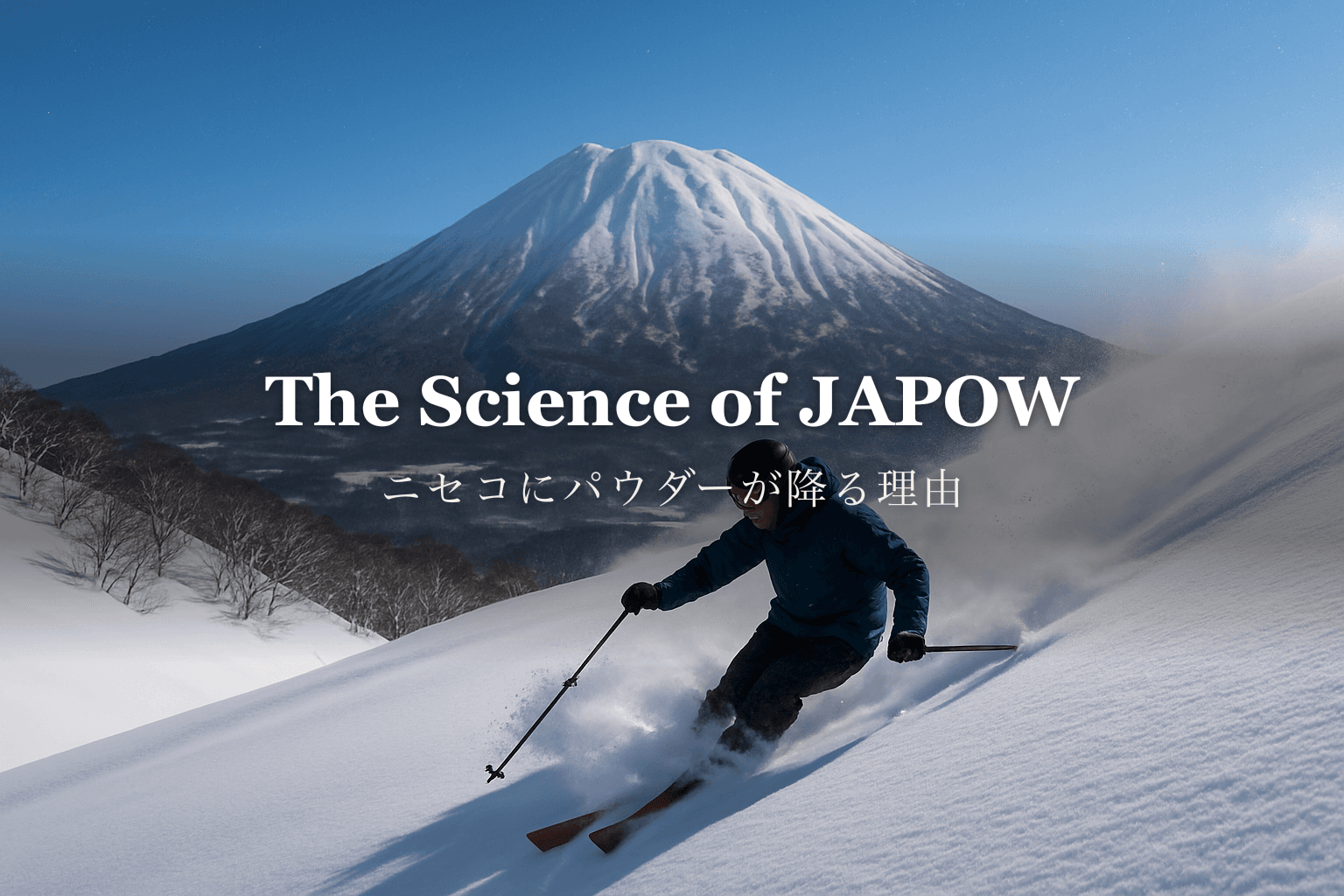
Why is Niseko's snow so light, and why does so much of it fall?
Skiers around the world call it "JAPOW" and dream of its dry, feathery powder. The answer isn't a single piece of magic. The Siberian High, the warm Sea of Japan, a belt of snow that forms over that sea, and Mt. Yotei — many conditions link up like a relay to create it.
This article unpacks how Niseko's powder comes to be — a little geeky, but gently.
- How much snow falls, and how light it really is
- The four weather mechanisms that make the powder
- Why it's so light (a look at snow crystals)
- When the snow piles up the most
Let's take it step by step.
Just how impressive is Niseko's snow?
The Niseko area gets around 12 to 15 meters of snowfall a year — among the most of any snow country on Earth.
But quantity isn't the whole story. The water content of the snow — the share of moisture it holds — is only about 7 to 8 percent in midwinter, which is remarkably low. Heavy snow along the Sea of Japan coast can top 9 percent, so you can see just how dry Niseko's snow is.
And it doesn't fall all at once and stop. Through the season it piles up almost every day. Wake up, and there's fresh powder again — an ordinary winter morning in Niseko.
Plentiful, light, and falling almost daily: this trio is why it's called JAPOW and draws people from around the world. So why does snow like this fall here? Let's go through it.
1. The Siberian High and the "west-high, east-low" pattern
It all begins on the Eurasian continent.
In winter, a vast high-pressure system (the Siberian High) builds over Siberia, while low pressure sits over the ocean to Japan's east. High in the west, low in the east — the "west-high, east-low" pressure pattern you often hear about in forecasts.
That pressure difference generates a cold, dry northwest seasonal wind, blowing straight from Siberia toward Japan. This is the powder's first runner.
But at this point the wind is bone-dry. Dry wind alone makes no snow. The next runner is the Sea of Japan.
2. The Sea of Japan, a giant humidifier
Before reaching land, the cold wind crosses the Sea of Japan.
This sea stays relatively warm even in winter, because a warm current (the Tsushima Current) flows in from the south. As the cold wind passes over the warm water, it takes up huge amounts of moisture and heat from the surface.
Think of the Sea of Japan as a giant humidifier. The dry air soaks up the makings of snow, and rows of snow clouds (cloud streets) develop one after another over the water.
Niseko sits right on that Sea-of-Japan side — in the front-row seat where the snow clouds first arrive.
3. The JPCZ: a "snow highway" over the sea
Here's where a properly geeky main character enters: the JPCZ (Japan Sea Polar-air Mass Convergence Zone).
When the winter pattern strengthens, the cold air from Siberia hits the Changbai Mountains near the base of the Korean Peninsula and splits in two. The two streams curl around the range and reconverge over the Sea of Japan. Along that line of convergence, snow clouds grow especially strong, forming a belt of snow up to 1,000 km long.
That's the JPCZ — a kind of "snow highway" over the Sea of Japan. Also called a linear snow band, it appears several times a winter, up to about ten in a busy year.
When this belt reaches toward Niseko, heavy snow can dump in a short time. Behind those back-to-back powder days is the work of this convergence zone.
4. Mt. Yotei and the Niseko peaks wring out the snow
Heavy with moisture, the snow clouds finally meet the mountains.
Mt. Yotei, the area's symbol, and the Niseko range that includes Annupuri. The clouds rush up the slopes to climb over them. The higher the air rises, the colder it gets; along the way its moisture cools, turns into snow crystals, and falls in heaps onto the slopes. This is orographic snowfall.
Here's the interesting part: a "drying" effect works too. Damp snow has already dropped much of its moisture on the coastal mountains, so by the time it reaches inland Niseko, the snow is drier still. That's why Niseko's water content is lower than on the coast.
The sea hands over moisture; the mountains wring it out, and dry it. This teamwork is what sustains Niseko's powder.
Why is it so light? Temperature and snow crystals
Plenty of places get a lot of snow. What makes Niseko special is how light it is.
The biggest key is temperature. Niseko's midwinter average sits around minus 8°C. It's properly cold.
When it's this cold, the snow holds little water. Low-moisture crystals stay fluffy instead of collapsing, so the snow feels dry in your hand and lifts into the air as you ride — the "champagne powder" people talk about. It feels nothing like wet, heavy snow.
Snow is a letter sent from the sky: Ukichiro Nakaya
The shape of a snow crystal is decided by the temperature and humidity where it forms. The first person to prove this through experiment was Ukichiro Nakaya, a physicist at Hokkaido University.
In 1936, Nakaya became the first in the world to create snow crystals artificially. He then mapped the relationship between crystal shape and temperature and humidity into a single chart (the Nakaya Diagram).
His famous words: "Snow is a letter sent from the sky." Read the shape of a crystal, and you can tell what the sky above was like when it formed.
Niseko's feathery powder is itself a letter, delivered from the cold, dry air far overhead. Seen that way, the snow in your palm looks a little more precious, doesn't it.
When does the snow pile up the most?
If you're chasing powder, late December to mid-February is prime time. January in particular is the most reliable month for both depth and lightness.
By March the snow turns a little heavier, but there's still plenty of it — and gliding through spring sunshine has its own charm.
You can check each day's snow and weather on the Niseko weather and snow forecast. Peek before you head out, so you don't miss a powder morning.
So — come ride Niseko
Siberian winds, the warm Sea of Japan, a belt of snow over the water, towering Mt. Yotei. Conditions from far apart join hands to deliver the powder the world dreams of to this one town.
Knowing the reason makes each run a little more precious. For where to find which kind of snow, take a look at the Niseko Four-Area Comparison Guide too.
Next time it snows, picture the journey each flake has made to get here. Then go — ride Niseko.
— Niseko Hub Editorial Team